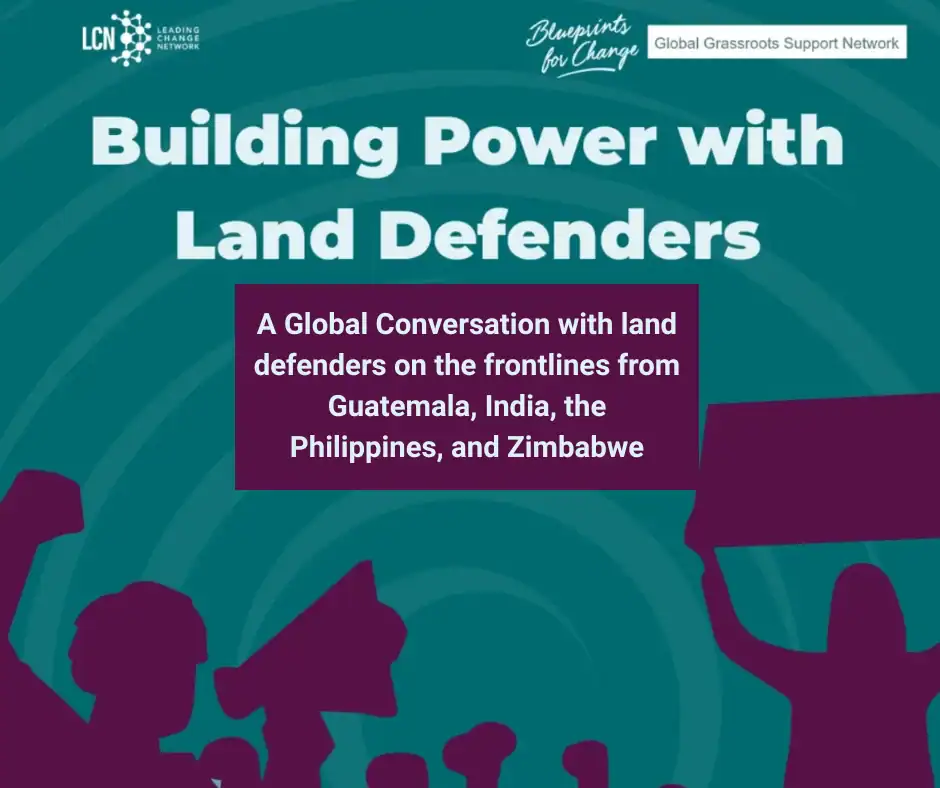

Building Power with Land Defenders Session Write-up
Antje Dun


-
Type
Articles
-
Region
Global
-
Practice
Coaching, Public narrative, Relationship building, Team structure, Strategy, Action
-
Language
English
Introduction
Whose land? Whose power? Whose protection? Around the world, land defenders are rising up against resource extraction, the displacement of Indigenous communities, and the exploitation of their lands. Are we listening? Are we standing with them?
Watch this recorded event (available in English and Spanish) that hosted a global conversation with land defenders on the frontlines from Guatemala, India, the Philippines, and Zimbabwe. The event was hosted by the Global Grassroots Support Network (GGSN) and Leading Change Network’s (LCN), on the 19th of June, 2025.
Key themes included how Indigenous land theft historically, and presently, is driving the need for land resistance efforts, and that there is no ‘just transition’ of fossil fuels without addressing the needs of the Global South.
More specifically, the presenters touched on how; communities can be empowered through storytelling, building up a diverse community network builds resilience, building broad alliances with one common goal if effective, and empowering most affected community members with knowledge and skills builds ownership.
Speakers
The event was moderated by Jacob Okumu (GGSN coordinator and LCN member) and featured the following speakers:
- Sandra Portela
Xinca community member, Director of Alternativas de Desarrollo para las Juventudes y las Mujeres (ADEJUM) Izabal, Guatemala - Christy Nag
Adivasi community member, Core member of Umul, an Adivasi led organisation in Dooars, West Bengal - Christian Jake S. Tabara
Youth Campaign Officer for the Alyansa Tigil Mina (ATM), the Philippines - Leonard Mabasa
Director for the Buhera Residents Network Trust, Zimbabwe
Watch Video
LCN x GGSN event Building Power with Land Defender (1 hour, 10 mins) – English Version
Evento LCN x GGSN: Construyendo Poder con los Defensores de la Tierra (junio de 2025) – Versión en español, Spanish Version
There was an old proficiency that would say that when the planets are about to collapse, we need to become warriors of the rainbow. And this is important to recognize and value our colours, our differences. And this comes from inside, to the outside because we know that oppression and inequality is already there. – Sandra Portela, Director of Alternativas de Desarrollo para las Juventudes y las Mujeres (ADEJUM) Izabal
Event Summary
Read a summary of the event. Here is a snippet below showcasing a coalition in the Philippines, called Alyansa Tigil Mina ATM. They are a coalition of organizations and groups who have decided to collectively challenge the aggressive promotion of large-scale mining in the Philippines.
- ATM is not advocating to ban all mining rather, they are advocating for an end to large scale mining which exploits mineral resources, undermining the value of land to Filipinos.
- In the Philippines, there are 6 financial agreements with over 103 hectares of land being mined. There are 305 permits for mineral processing, with shared agreements for 548 hectares of land. There are 49 registered community mines.
- ATM is resisting against the destructive impacts of environmental degradation, water pollution and biodiversity loss. Where there is mining, there is drought, air pollution, water pollution from their extraction, and other kinds of pollution.
- There’s also a disruption of livelihood for farming, fishing and the use of ancestral domains.
- Based on the global witness report, the Philippines is the number one place in Asia where land and environmental defenders are threatened, and worse, being killed. The Philippines is third in the whole world after Brazil and Colombia.
- In the Philippines, there’s also corporate and state collusion. Companies are joining the race for a position like Senate or Congress to ensure that there’s no laws being passed that delay their businesses.
- There is weak legal enforcement of environmental laws and accountability mechanisms. The government or the ministry of environment is selling the Philippines to foreign investors, effectively greenwashing mining operations in the country.
This mining is also exacerbated with the just transition that the global north is pushing for the energy transition for solar energy, wind energy or e vehicles. But there are communities in the Philippines that are suffering because of these transitions. So the just transition is kind of absent in the process and there are sacrifice zones like the Philippines, Indonesia and some parts of the global south. –Christian Jake S. Tabara
Video
This video showcases the work of ATM. It includes a song composed by young people in the Philippines called “Ipamana Huwag Ipamina.” Ipamana means to inherit or to pass on. Huwag means don’t and is for mining. It translates to inherit it, don’t mine it.
We do community assemblies, Indigenous councils in Barangai level or village level to raise awareness amongst mining affected communities and create support from those who are not directly affected. Say, for example, in Metro Manila or universities near mining affected communities. And we also create solidarity networks among farmers, fisher folks, youth and translating it into more marginalized sectors like women, members of the LGBTQ, disabled people. So we’re also in the process of creating policies for these things and then we also have public campaigns, legal and policy engagement and cultural resistance. – Christian Jake S. Tabara
Calls to action
- Calls to action for the public include –
- advocating to learn more about the effects of mining,
- supporting grassroots efforts through donations,
- volunteering,
- amplifying their stories by creating and sharing content to highlight local struggles and victories, and
- advocating for community-based alternatives like solidarity economies, ecotourism and agroecology.
- For the government, they are calling on officials to
- enforce stricter environmental regulations,
- ensure environmental laws are observed, and
- prioritize renewable energy and a just transition in communities.
Every ore, every mineral is being transported and we’re not benefiting from what they are getting from our earth. And we are also lobbying for the Senate and Congress to pass an alternative minerals management bill which will include community participation in the decision making process… Because of the bureaucratic capitalism where mining companies back politicians during elections, they will ensure that there’s no law that will be passed to protect the environment so that they can continue the extraction like business as usual. –Christian Jake S. Tabara
Explore more about Alyansa Tigil Mina ATM
Read Full Summary
Explore Further
- Land Defence and Defenders, The International Work Group for Indigenous Affairs (IWGIA)
IWGIA is a global human rights organisation dedicated to promoting and defending Indigenous Peoples’ rights. - Alliance for Land, Indigenous and Environmental Defenders ALLIED
A global network of civil society actors that drives multi-stakeholder action and systemic change in the recognition, support, and protection of Indigenous, Land, and Environmental Defenders (ILEDs). - Indigenous Climate Action
Indigenous Climate Action (ICA) is an Indigenous-led organization guided by a diverse group of Indigenous knowledge keepers, water protectors and land defenders from communities and regions across the country. - Land Rights Defenders Inc.
Land Rights Defenders is an Indigenous led 501(c)(3) public charity with its core mandate to protect the rights of landowners and ensure a safe and equitable environment for indigenous and native groups by advocating for fair and just land policies or practice and taking legal action where necessary. - Resources for Defenders, Earthrights International
EarthRights is a non-governmental, non-profit organization that combines the power of law with the power of people in defense of human rights and the environment, which we define as “earth rights.” We take legal action against perpetrators of earth rights abuses, train activists, and work with communities to demand meaningful and lasting change. - Land and Environmental Defenders, Global Witness
Hundreds of land and environmental defenders are threatened, arrested and killed every year for their part in resisting environmental devastation. We record every name and honour their activism.
The original version of this report was published here on the Commons Social Change Library. It is a summarized version of the full report, which was published here on Global Grassroots Support Network.
Resource Information
- Year: 2025
- Author: Antje Dun
- Tags: —
- Access : Public
- Topics : Indigenous justice and decolonization
- Regions : Global
YOU MIGHT LIKE


The Resource Center thrives on the generosity of people like you.
Share your wisdom with the community. Submit a resource today!
Share With the Community