

Formerly Incarcerated Convicted People and Families Movement (FICPFM) Organizer Training Fellowship: Winning Campaigns to Transform the Criminal Justice System During Covid 19 and Beyond: Digital Manual and Digital Coaches Guide
Abel Cano, Anjali Rodrigues, Formerly Incarcerated Convicted People and Families Movement (FICPFM), Jeff Rousset, Miya Cain


-
Type
Guides and slides
-
Region
North America
-
Practice
Coaching, Public narrative, Relationship building, Team structure, Strategy, Action
-
Language
English
Digital Manual – Introduction
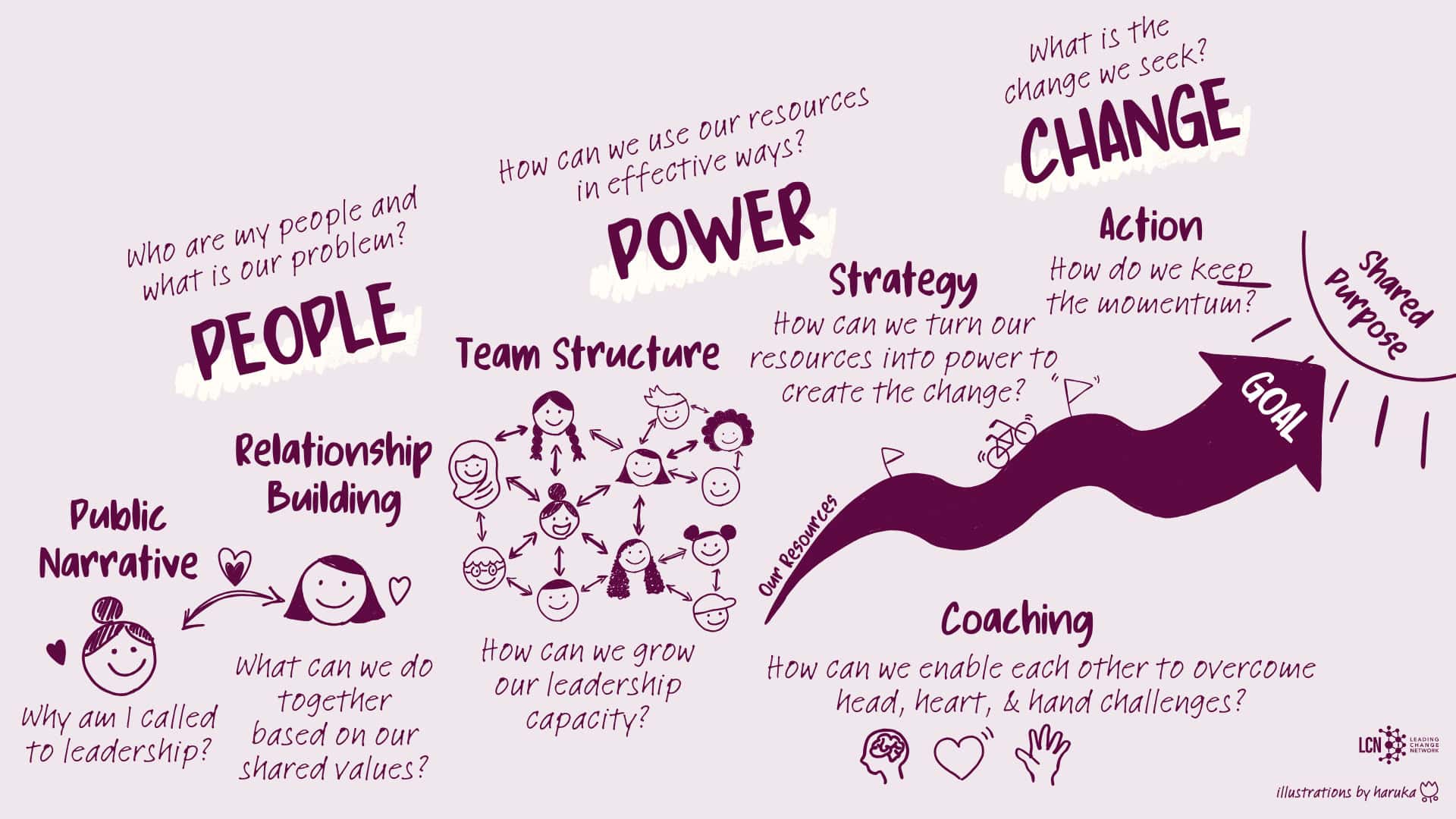
The goal of this manual is to introduce you to an organizer’s perspective on leadership. Organizing can be learned as a leadership practice based on accepting responsibility for enabling others to achieve purpose under conditions of uncertainty: identifying, recruiting and developing leadership, building a constituency around that leadership, and transforming the resources of that constituency into the power they need to achieve their purposes.
This manual features links to multimedia resources. It was originally designed as a printed participant manual to be used during and after in-person organizing workshops. Since many of the resources used for workshops and related materials are now available digitally, we hope this manual will be useful for civic engagement practitioners who may or may not have attended workshops in person. Of course reading this manual will not be enough to produce any deep learning. This manual is meant to accompany practice and reflection, both individually and in leadership teams. We hope you will put it to good use in your campaigns!
There are five basic organizing leadership practices covered in this guide:
- How to translate values into the motivation for action by learning to tell a story of why you are called to lead, a story of your constituency, and a story of an urgent challenge that requires action: self, us, and now.
- How to build intentional relationships as the foundation of purposeful collective action.
- How to structure a collaborative leadership team with shared purpose, ground rules and clear roles.
- How to strategize turning the resources of one’s constituency into the power needed to achieve clear goals.
How to secure commitments required to generate measurable, motivational, and effective collective action.
Contents
- Introduction………………………………………………………………………….. p. 4
- People, Power, Change: What are the core leadership practices for organizing? …. p. 7
- Leadership Practice: Public Narrative 1 – Story of Self……………………….. p. 20
- Leadership Practice: Relationship Building………………………………………… p. 34
- Leadership Practice: Building Leadership Teams……………………………….….. p. 44
- Leadership Practice: Public Narrative 2 – Story of Us………………………..……. p. 55
- Leadership Practice: Devising Shared Strategy……………………………….…… p. 66
- Leadership Practice: Mobilizing Shared Commitment – Action…………..……….. p. 85
- Leadership Practice: Public Narrative 3 – Story of Now and Linking Self+Us+Now p. 97
- Appendix: Coaching as a leadership practice……………………..……………… p. 109
Download Resource
Digital Coaches Guide – Introduction
Welcome aboard and thanks for joining our Facilitation Team! These pages offer you some tips for facilitating your teams, based on what we learned designing and coaching an online fellowship for formerly incarcerated people and others impacted by the legal system. This training occurred in 2020, in the midst of the global COVID-19 pandemic and a heightened national awareness of the longstanding systemic racism and state-sanctioned violence that made it even more urgent for directly impacted people to fight for change.
This facilitation guide includes:
- A description of the PEDAGOGY of learning and teaching organizing. We believe providing deeper insights into why we teach organizing in the way we teach it will enable you to more wholly embody the principles of this powerful framework in your leadership practice.
- The ROLES AND RESPONSIBILITIES of a coach and facilitator.
- A WALK-THROUGH of how to successfully and effectively facilitate the organizing training sessions, with notes on how to best implement online.
- BEST PRACTICES on coaching strategies to address common challenges and questions. The tips and strategies provided move from general to specific, guiding you through the coaching process for each module. We begin each section with a focus on key learning objectives. These objectives are intended to guide your decision-making process as a facilitator. We have also included common challenges you may encounter along the way. Know that we have all experienced challenges on our ongoing journey of discovery and practice.
- CONSIDERATIONS for adapting this training for the variety of communities that you may work with and for adapting this training to the virtual context.
Please plan to use this guide in conjunction with the digital organizing manual for participants that includes a more in depth explanation of the organizing practices.
At the end of the day, while these may be helpful there is no script. We find it helpful to engage this process with a growth mindset about your own capacity for learning. Trust your judgment and remember that leadership is accepting responsibility for enabling others to achieve shared purpose in the face of uncertainty. It all starts with you owning your role and using that role to support others to do the same.
Thank you in advance for your commitment to building the capacity of people and communities to envision and realize a more equitable and just world. We look forward to learning and having fun together!
We’re here to support you.
Miya Cain, Abel R. Cano & The FICPFM Fellowship Training Team
Download Resource
FICPFM Digital Coaches Guide for Organizing _ Summer-Fall 2020
Resource Information
- Year: 2021
- Author: Abel Cano, Anjali Rodrigues, Formerly Incarcerated Convicted People and Families Movement (FICPFM), Jeff Rousset, Miya Cain
- Tags: Action_Commitment, Coaching, Criminal justice, Facilitation, Leadership_Leadership development, Organizing, Public Narrative_Story, Relationship building, Story of Self Us Now
- Access : Member-only
- Topics : Racial justice and abolition
- Regions : North America
Become a Member
- Access to exclusive resources and content
- Connect with the Leading Change Network community
- Participate in member-only events and discussions
YOU MIGHT LIKE




The Resource Center thrives on the generosity of people like you.
Share your wisdom with the community. Submit a resource today!
Share With the Community