

HAIYYA Campaigner’s Guide, To build/strength of your community & Campaign [an affiliate of Leading Change Network, based in India]
Haiyya Foundation


-
Type
Guides and slides
-
Region
Global
-
Practice
Coaching, Public narrative, Relationship building, Team structure, Strategy, Action
-
Language
English
Introduction
An amalgamation of simple tools to assess your community’s leadership growth and campaign journey from Haiyya and based on the work of Marshall Ganz. The tools are presented as slides and available in PDF format below.
Why Assessment?
- Campaigning is as challenging as exciting it is to bring change!
- At times, we miss assessing ourselves that might lead to further challenges
- For a campaigner, it is crucial to assess, understand, delve deeper into learnings and re-strategise as and when needed
- We present to you an amalgamation of simple tools to assess your community’s leadership growth and campaign journey, from time to time and meet your campaign goal
- We are looking at it from the lens of community organizing that was introduced by Prof. Marshall Ganz of the Harvard Kennedy School and is adapted and tweaked by Haiyya in the Indian context
Instructions: How to use this tool
There are 3 sections and 3 tools:
- Leadership development, Prototyping interventions and Campaign Health Assessment
- Each section has to be reviewed and assessed before planning for a campaign milestone or peak
- There are indicators that help in understanding what needs to improve at what time
- Specific instructions are shared on each sheet- Please look at them minutely to assess your campaign and leadership growth
- At the end, there are also some tips and additional tools for you!
Just for you to get started!
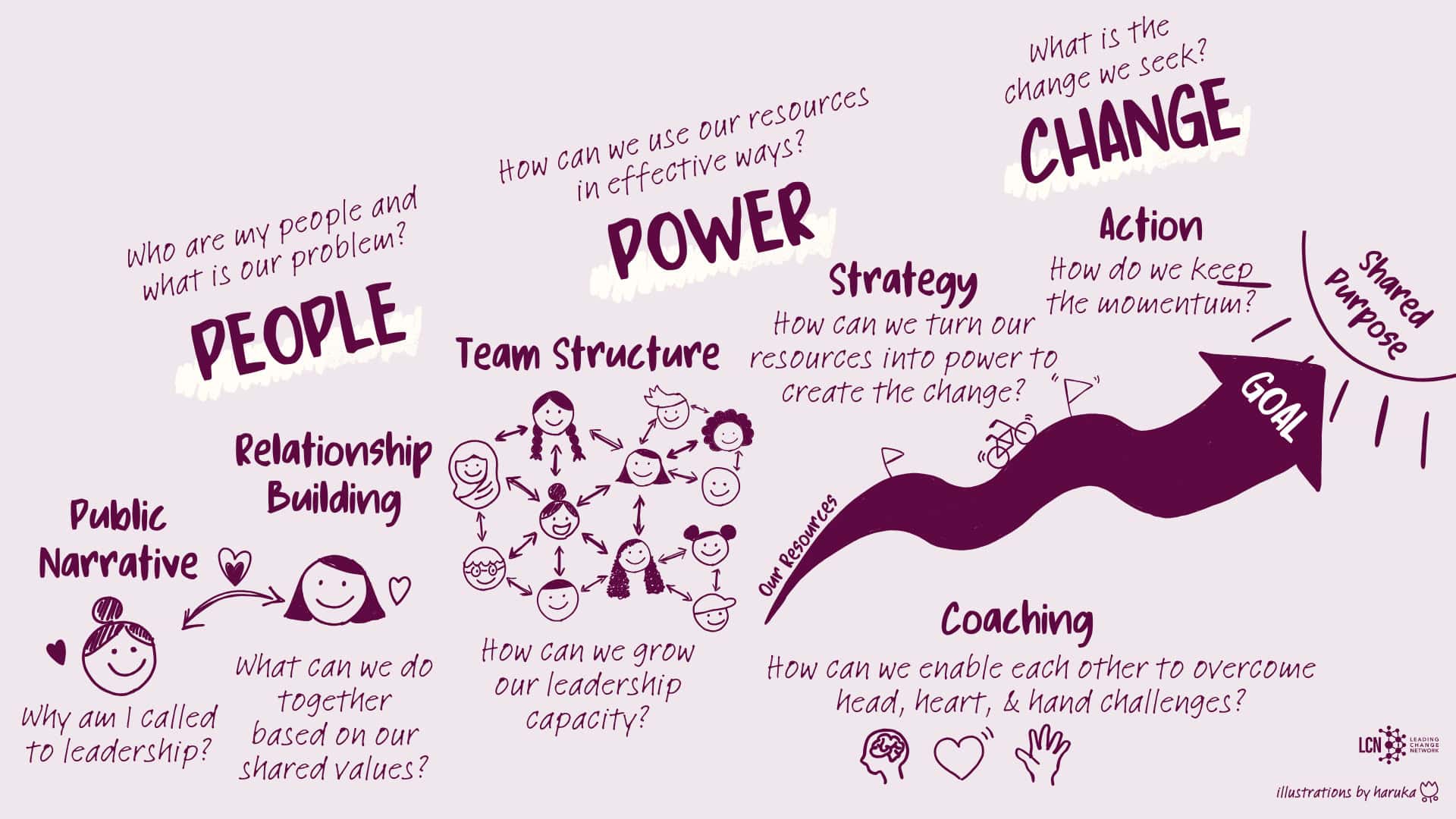
Any social, political and cultural change can be brought about by first understanding one’s calling to leadership. Then finding more people who share similar values and passion and finally catering to the urgency of the situation. It requires taking leadership! Leadership is accepting responsibility for enabling others to achieve shared purpose under conditions of uncertainty.
Organizing Terminologies
Get acquainted with organizing terms and language to get started.

 Keep in Mind
- Organizing is not about taking responsibilities all by yourself or working in isolation
- Organizing is to enable leadership capacities, growth and development of your people.
- Begin thinking by putting yourself at first to understand what is your call to leadership?
- Create a shared purpose and story of us with your people sharing same values, and then taking it up immediately to address the current situation
- As an organizer inculcate a culture of giving and taking ownership
- Bring change together
- Acknowledge your challenges and celebrate smallwins together
- As a campaigner, keep your team motivated
Community Leadership Growth Assessment – Campaign User Journey (Tool 1)


Intervention to Re-Strategize – Tool: Paper Prototype (Tool 2)
Why Prototype?
To create quick and rough prototypes of the campaign solution and test with audiences and allies to determine key project activities and improve ideas through feedback.
What is the Outcome?
At the end of this stage you should have a clear direction for the campaign solution and as well as feedback from audiences to build on and improve ideas for implementation.
Get started with Prototyping
Make: Prototypes are not a final representation of your solution and can take many forms. Start by creating a quick and simple prototype and you can become more detailed as the idea evolves.
Test: Prototypes are a vehicle for feedback from your target groups. It is important to get honest, contextual feedback from people, and this requires you to maintain some detachment from ideas so that you can listen and take in feedback.
Learn: Failure is an accepted part of the human-centred design process. Learning from experimentation and prototyping increases the likelihood that the end result will be a success.
Iterate: Iteration is an important practice in this learning, allowing you to explore and evolve the solution.
Keep in Mind
1. Keep it simple and scrappy. Prototype what you need with minimum level of detail. Simple prototypes make people focus on the general idea. You’ll also get more honest and constructive feedback if ideas don’t look finished or polished.
2. Quantity vs Quality. It is better to make many prototypes and get a lot of input, instead of focusing on making one perfect prototype. So build fast, rough and basic prototypes.
3. Narrow focus to key ideas; you can add more detail as idea evolves.
4. Ask one question at a time. Break big ideas down into smaller pieces so you can get clear answers to specific questions.
5. Doing not talking. If you have to spend a lot of time talking, your ideas may be too complex. Be specific about language and images so that people can understand the idea with little explanation.
6. Don’t fall in love. Your first ideas may be great, but later ones will be better. Never fall in love with an idea or prototype. Be prepared to throw it all away after testing.
7. Make the process short term- it should be quick and prompt, before you get to understand your learnings and put them to use.
Prototyping through Role Playing
- Decide what elements of your idea you want to role play and assign roles in the team.
- Spend about 30 minutes defining the key elements of the role play with the team.
- Try it out in your team first to practice and refine.
- Costumes or props can be useful tools for bringing your role play to life and make it more realistic.
- Hit the streets and test with your target audience.
-Role play is a fun exercise and an exciting way to map the needs of your community, come up with interventions, test it with them and you can streamline it to develop your strategy for final interventions!
-While role playing, you have to actually be present and take part, either on the streets, offline or online
-It gives you an understanding of what the real challenge is, why do you need to intervene and where do you need to intervene
-Your learnings will help in restrategising

Campaign Peaks and Journey Assessment – Campaign Health Document (Tool 3)


Resources and Tips


Thank you and have fun assessing your leadership.
Download Resource
HAIYYA Campaigner’s Guide, To build/strength of your community & Campaign
About Haiyya
Haiyya is a global affiliate of Leading Change Network, a global community of organizers, educators and researchers.
Haiyya was founded in 2015, with a vision to rebuild and transform the social fabric of India, where young leaders and their organisations are building grassroots citizen power to strengthen democracy, governance and human rights. We equip social changemakers, organizations and citizen groups to learn, innovate and adapt to the needs of the changemaking landscape. Using cutting edge modern day campaigning and community engagement frameworks, we create a loud thumping voice of participatory, people-powered programs.
Explore Further
Resource Information
- Year: 2022
- Author: Haiyya Foundation
- Tags: Evaluation_Assessment, Haiyya - India (Organization - Organizing Group), Leadership_Leadership development, Organizing
- Access : Member-only
- Regions : Global
Become a Member
- Access to exclusive resources and content
- Connect with the Leading Change Network community
- Participate in member-only events and discussions
YOU MIGHT LIKE
The Resource Center thrives on the generosity of people like you.
Share your wisdom with the community. Submit a resource today!
Share With the Community