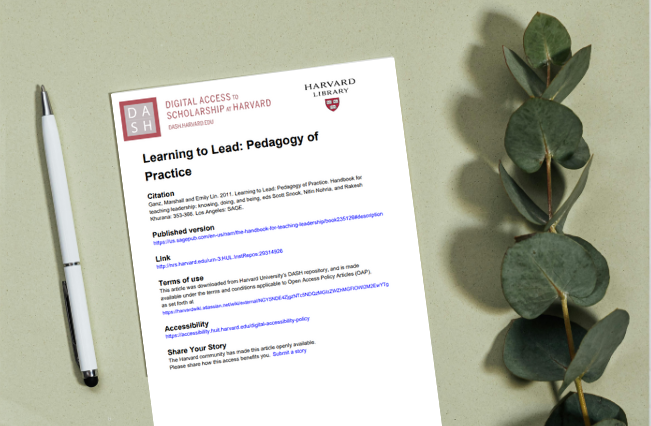

Learning to Lead: A Pedagogy of Practice [Book chapter in Handbook for teaching leadership: Knowing, doing, and being]
Emily S. Lin, Marshall Ganz


-
Type
Books
-
Region
Global
-
Practice
Coaching, Public narrative, Relationship building, Team structure, Strategy, Action
-
Language
English
Introduction
Marshall Ganz and Emily S. Lin set out four learning structures – projects, scaffolds, reflections and contexts – that enable them to engage in pedagogy as practice.
The four structures are (direct quotations from the Ganz and Lin paper):
- Project-focused learning: If, as teachers, we model leadership by enabling our students to achieve purpose in the face of the uncertainty of their projects, then students begin to actually learn leadership through their experience of commitment to an organizing project.
- Scaffolded learning: Learning new skills requires venturing beyond the limits of one’s perceived competence—a step both exciting and frightening, and one that requires motivational, conceptual, and behavioral resources. Scholars describe this uncharted territory as a “zone of proximal development”—a space between what an individual will do on their own and what they will undertake with the encouragement of another—parent, teacher, or coach (Vygotsky, 1978). Just as one must fall to learn to keep one’s balance on a bicycle, “training wheels” can, for a time, help a learner acquire courage to face the moment when they must come off. The pedagogical challenge is deciding when such “scaffolding” provides productive support, and when it inhibits development. We offer scaffolding for the hands (behavioral), for the head (intellectual), and for the heart (motivational) (Hackman & Wageman, 2005).
- Critical reflection: Among the challenges of teaching leadership are assumptions students bring with them about familiar skills that may serve perfectly well in private life, but not in public life—such as how to build relationships. While scholars of learning emphasize the need to engage prior knowledge explicitly when building new knowledge (Strike & Posner, 1985; Bransford, Brown, & Cocking, 1999), unexamined assumptions about leadership are especially challenging. Although few people may have prior knowledge about, for example, quantum physics, everyone has theories about how to build relationships, tell stories, and strategize outcomes.
- Cross-contextual learning: Deep understanding of practice requires learning how to distinguish what is particular to a given context or content from what is core to the integrity of a process. For example, when it comes to building relationships, cultures vary widely in their rituals of expectation, encounter and follow-up. But relationships themselves grow out of reciprocal exchange between parties, commitments reaching beyond a single exchange, and the possibility of future utility, growth, or learning.
Conclusion
In this paper we argue that leadership not only can be but, in fact, is taught in classrooms, communities, campaigns and associations—but it could still be done much better. We’ve specified some ways to structure this kind of learning. We hope our work contributes to a move away from leadership development as a process of selecting extraordinary individuals, giving them extraordinary opportunities, and expecting extraordinary things from them. One alternative is to understand leadership development—and leadership itself—as a practice of accepting responsibility for enabling others to achieve purpose in the face of uncertainty, a practice which itself develops new leaders. Given the increasing uncertainty of life in our rapidly changing world, growing fragmentation, and increasing stratification, the need for leadership is greater than ever. We hope our pedagogy can help equip us to meet this challenge in a better, more interdependent way
Resource Information
- Year: 2025
- Author: Emily S. Lin, Marshall Ganz
- Tags: Leadership_Leadership development, Teaching_Pedagogy_Courses
- Access : Public
- Regions : Global
YOU MIGHT LIKE



The Resource Center thrives on the generosity of people like you.
Share your wisdom with the community. Submit a resource today!
Share With the Community