
People, Power, Change: Five Leadership Practices of Organizing (Illustration)
Haruka Sano


-
Type
Guides and slides
-
Region
Global
-
Practice
Coaching, Public narrative, Relationship building, Team structure, Strategy, Action
-
Language
English
What is the People, Power, Change framework?
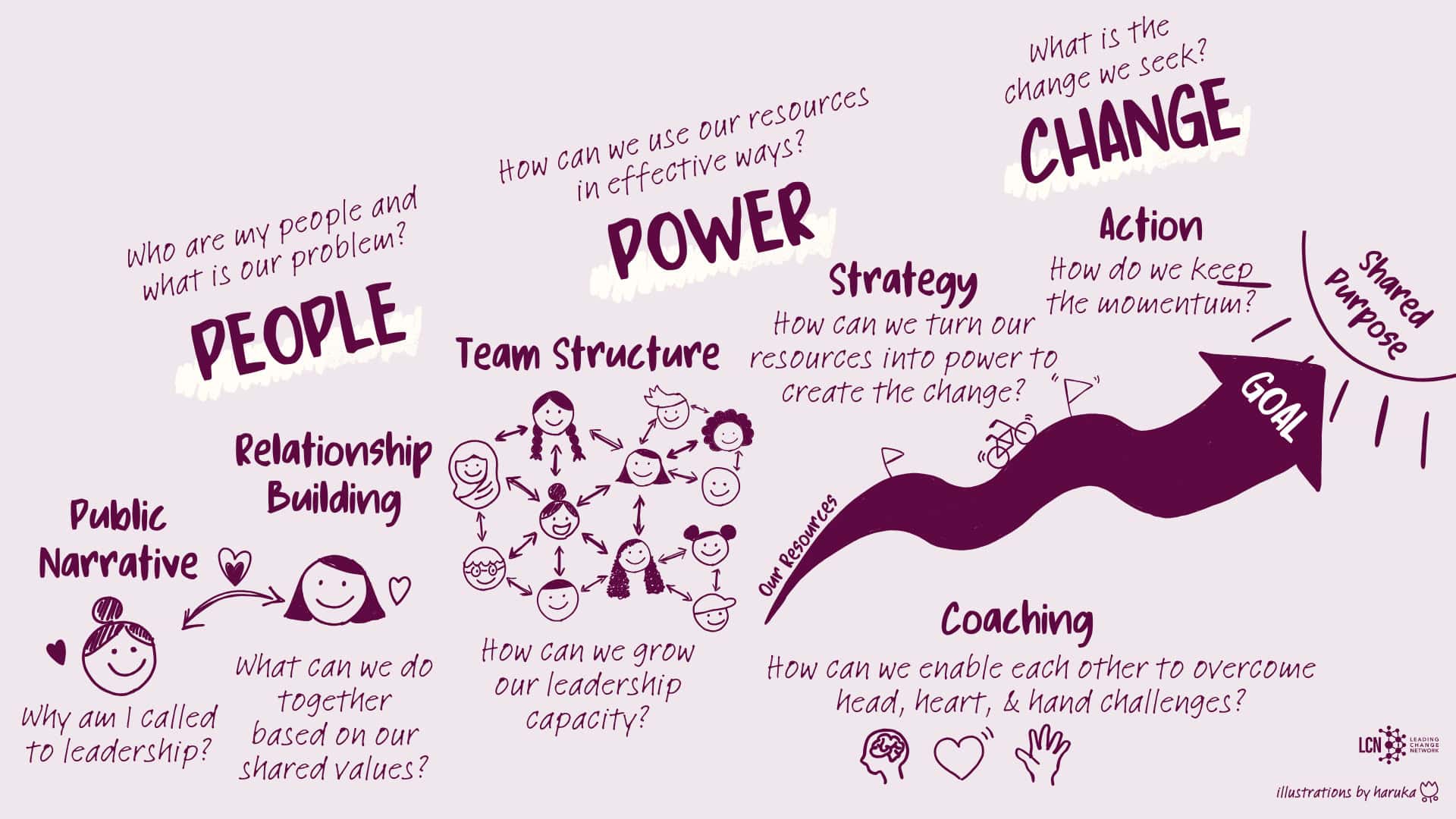
People, Power, Change is the organizing framework developed by Dr. Marshall Ganz at Harvard University and his associates. It is centered around the three questions:
- People: Who are my people (and what is our problem)?
- Power: How can we use our resources in effective ways?
- Change: What is the change we seek?
What are the five leadership practices of organizing?
The five leadership practices of organizing support the People, Power, Change framework.
- Public narrative: Why am I called to leadership?
- By telling the story of who I am, who we are as a community, and what choice we can make in this urgent moment, we invite others to act on their values and join in our collective action
- Relationship building: What can we do together based on our shared values?
- By asking each other not just what we are interested in but why we are interested in it, we build transformational relationships with strong commitments that become the foundation of our structure
- Team structure: How can we grow our leadership capacity?
- By creating a shared purpose, building norms and assigning roles, we develop each other’s leadership in interdependent teams and hold each other accountable to collective action
- Strategy: How can we turn our resources into power to create change?
- By focusing on a tangible change and hypothesizing how to achieve that change through power analysis, we build concrete pathways to change that result not just in a campaign win but also individual and organizational growth
- Action: How do we keep the momentum?
- By effectively mobilizing others and engaging them in well-designed actions, we increase in number and build our power to achieve our goal
We also practice coaching throughout, enabling each other to overcome head, heart, and hand challenges. By asking questions and trusting that the other person has the capacity to draw out their own answers, we grow each other’s leadership.
How can I use this illustration?
You are welcome to use this illustration in your practice of organizing and training.
(Please keep the attribution at the bottom right corner and do not modify it.)
If you want to modify the illustration, have any requests for other illustrations, or are interested in translating it to other languages, please feel free to reach out to the illustrator, Haruka Sano (haruka.sano@leadingchangenetwork.org).
Hope this illustration helps you in your People, Power, Change journey!


Japanese version available:

Further resources
For more resources, you can read People, Power, Change: Organizing for Democratic Renewal by Marshall Ganz, or you can visit What is Organizing.
You can also read how the People, Power, Change framework has been used all around the world:
- Boresha Elimu Campaign: Bringing 1,200 children back to school in Ngong’, Kenya in 2014 (Case study)
- Case Study: Let Me Keep My Childhood “La Tkabrouna”
- Building “People Power” Against the Sell Out of Serbia to Mining Companies
- Health over Stigma: Campaign Report (India)
If you are an LCN member, you can also start thinking about these questions by filling out the Organizing Practices to Build Power for Change Worksheet.
Resource Information
- Year: 2025
- Author: Haruka Sano
- Tags: —
- Access : Public
- Regions : Global
YOU MIGHT LIKE
The Resource Center thrives on the generosity of people like you.
Share your wisdom with the community. Submit a resource today!
Share With the Community