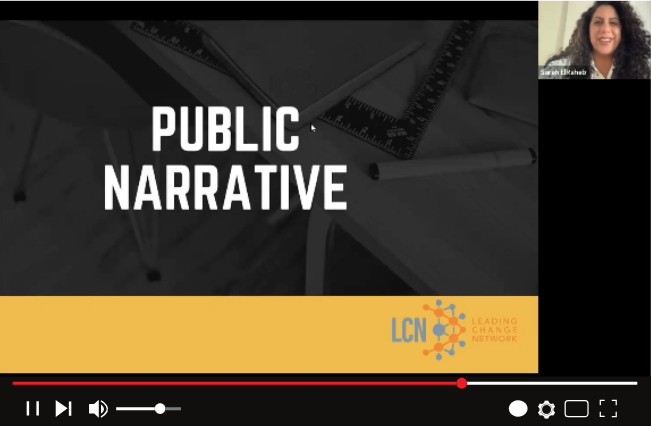

Public Narrative Explained By Sarah ElRaheb (Video)
Sarah ElRaheb


-
Type
Videos
-
Region
Global
-
Practice
Public narrative
-
Language
English
In these videos, Sarah ElRaheb explains the essential concepts of public narrative and storytelling introducing story of self, us, now, and linking
Introduction to Public Narrative
One aspect of leadership is using public narrative. To lead is to accept responsibility for enabling others to achieve shared purpose in the face of uncertainty. As individuals, as communities, and as nations, we can learn to respond to the challenges of an uncertain world by accessing moral or emotional resources through narrative. Empathy over alienation, self-worth over self-doubt, and the ability to draw on optimism over fear are all qualities that are necessary for us to respond to critical situations deliberately and with agency.
Story of Self
In this video, we focus on learning to tell a “story of self”: a story the purpose of which is to enable others to “get you” – to experience the values that call you to leadership on behalf of your cause, in this place, at this time.
Story of Us
The goal of a “story of self” is to enable others to “get you.” The goal of a “story of us” is to enable others to “get each other”. We tell a “story of us” to move others to join with one in collective action based on values they share. It is not a “categorical” us – people who fit into a particular category. It is an “experiential” us – people who may share certain values, rooted in common experience. This “us” is rooted in the experience of the “people in the room.” It works when people feel part of an “us.” In this video Sarah explains to us how to craft story of us, the us in the room
Story of Now
We tell a Story of Now to communicate an urgent challenge faced by “us” that demands a choice to act: a compelling image of what will happen if we do not act, a hopeful vision of what could happen if we do act, and a call to commitment to the choice required. The “character” in a story of now is you, the people in the room with you are your us, and the response you make is the now. answering the question why does it matter? and why now? In this video Sarah tells us how to turn an important challenge into urgent by the craft into storytelling
Linking Narrative
So how do we put the three stories together? Your story of self is the foundation. Without a story of self why would anyone think you really know what you’re talking about. This is about life experience not technical expertise. Without a story of us there’s no leadership. Exercising leadership requires engaging others in working together. And without a story of now nothing happens. The thread that unifies all three is the values in which they are rooted. Their effectiveness is rooted in the power of the story moments (challenge, choice, outcome) with which it is built. In this video Sarah teaches us why and how we should tell the three stories together
About Sarah Elraheb
Sarah ElRaheb-Dagher is a Canadian-Egyptian educator and coach who specializes in teaching public narrative, organizing, and leadership. She has her Master’s in Education from Harvard Graduate School of Education, with a focus on the arts in education, and has spearheaded the design and implementation of many large-scale education projects, including an executive education course of the Public Narrative course taught through HKS, and an intensive curriculum for mayors from around the world through the Bloomberg Harvard Initiative. She has coached, taught, and coordinated over 100 Public Narrative and Organizing workshops across the United States, Canada, and beyond, coaching hundreds of individuals, including artists, mayors, congresspeople, Dreamers, grassroots organizers, and TED talk speakers.
Sarah has collaborated with LCN on many brilliant projects, such as leading the Freedom Initiative public narrative workshop, being the design lead for the first FICPFM fellowship, in addition to being the lead coach for a Training of Trainers program for the same fellowship.
She co-lead the first ever LCN ToT program alongside Mais Irqsusi!
Resource Information
- Year: 2022
- Author: Sarah ElRaheb
- Tags: Capacity building, Leading Change Network LCN, Public Narrative_Story
- Access : Member-only
- Regions : Global
Become a Member
- Access to exclusive resources and content
- Connect with the Leading Change Network community
- Participate in member-only events and discussions
YOU MIGHT LIKE


The Resource Center thrives on the generosity of people like you.
Share your wisdom with the community. Submit a resource today!
Share With the Community