
Strategy III: Snowflake & Metrics
Mais Irqsusi


-
Type
Guides and slides
-
Region
Global
-
Practice
Strategy
-
Language
English
Metrics
In organizing, data, evaluation and reflection are critical in enabling our strategic use of limited resources, our setting goals and maintaining accountability, and our demonstration of success and power.
- We must learn what is and isn’t working, and modify our plans accordingly
- We must hold ourselves accountable for building leadership and winning campaign outcomes
- We must report and communicate progress and success to our community and stakeholders (Build our narrative of power and progress!)
Goals measure consequential outcomes that are achieved over a long period of work. Metrics, on the other hand, track the activities that people engage in day to day. Metrics are not an end in themselves, but a way to help you decide which activities are helping you the most in meeting your overall campaign goals, so that you can re-strategize over time.
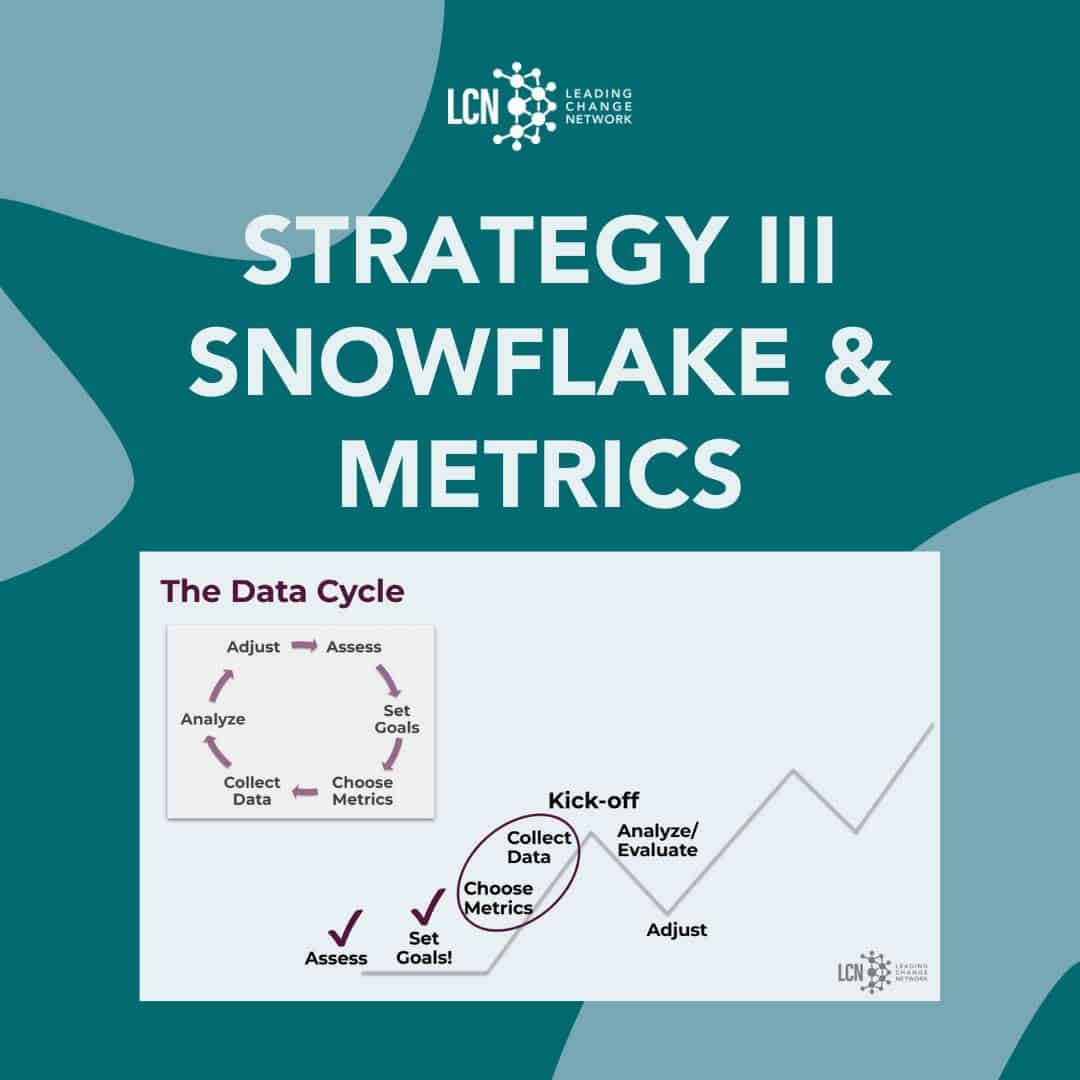
The data cycle helps us plot, measure, and hold ourselves accountable to our peak and overall goals. The cycle spreads and repeats across the tactics and timeline. The intent of the cycle is to constantly be asking, “Are we on track to win?” Analyze the data you collected, and if you’re not on track, adjust. What will it take to win? Set the goals and metrics to make it real? A good campaign has real time counting, not just after peak. That’s the use of team meetings and data roles in teams. Monitor as we work in teams as an ongoing strategizing process, and when necessary, take intentional stops for the whole campaign to shift strategy.

In order to develop metrics of success, we start from the end goal that we need to reach and work backwards to see what inputs and outputs are needed for us to reach our goal. Use the worksheet below to set the metrics for your campaign.
Tips
- Doing numbers includes hypothesis creation and testing. If I want 20 people to show up to a house meeting, how many should I contact? How many confirmations shall I have? There are no rules for this except for practice. The more skilled we become as organizers, the more our expectations will meet the goals.
- Sometimes as we work backward from the goal to output, input and then leaders, we need to go forward as we realize changes. It’s not a linear process.
- Sometimes as we develop metrics, we realize the need for new tactics that we didn’t create in our tactics brainstorm. As long as they help us reach the goal and don’t contradict how we think the world works (our theory of change), then we should add them and plan them into our action program.
Snowflake
We decide on our campaign goal, build our theory of change, and create our campaign timeline… but there is often a gap between building the campaign timeline and figuring out a snowflake structure that can make the campaign timeline happen. Once we have the campaign timeline, and have broken down the peaks into outputs, inputs, and the number of leaders, then we analyze the leadership needed to build the snowflake structure.
In a snowflake model of leadership, leadership is distributed. No one person or group of people holds all the power; responsibility is shared in a sustainable way, and structure aims to create mutual accountability. The snowflake is made up of interconnected teams working together to further common goals. A campaign’s strength stems from its capacity and commitment to develop leadership. In the snowflake model, everyone is responsible for identifying, recruiting, and developing leaders. Leaders develop other leaders who, in turn, develop other leaders, and so on.
Constituency team is a team that is in the constituency. For example, if the constituency is mothers organizing for childcare, then building a team of mothers or grandmothers in City A that has no childcare is building a constituency team.
Functional team or technical team is a team that has a specific functional role that manifests a campaign strategy, such as data, media, or legal. Again, these teams are helpful to build, only if their presence as separate teams is important for coordination.
Also note that a common practice is to have functional or technical roles inside constituency teams that also meet together. For example, it can be helpful to have a data person from each constituency team that then meets as a data team in a parallel functional structure, in addition to belonging to the main constituency teams.
Use the worksheet below to design the snowflake for your campaign.
Tips
- Some campaign responsibilities are very crucial but can be managed better with one or two people holding that responsibility, and do not require a team
- Some campaign responsibilities are very crucial but temporary. For example, when thinking about creating a research team, consider what that team turns into after the research is over
- Always remember that we build teams where we need to build power in our people. Thus, constituency teams are the most essential in our snowflake
- Constituency teams snowflake, while functional teams might not need to grow but could have a role in each constituency team to coordinate with
- Some teams might be necessary based on the theory of change. For example, if the theory of change includes threatening reputation through media, having a media person or a media team might be necessary. The question is: Is it a team or a role in each constituency team?
Resource Information
- Year: 2025
- Author: Mais Irqsusi
- Tags: —
- Access : Member-only
- Regions : Global
Become a Member
- Access to exclusive resources and content
- Connect with the Leading Change Network community
- Participate in member-only events and discussions
YOU MIGHT LIKE




The Resource Center thrives on the generosity of people like you.
Share your wisdom with the community. Submit a resource today!
Share With the Community